You’ve stumbled upon a property that looks promising. As you scroll through listings, attend open houses, or even receive a direct mailer, that spark of potential ignites. But before you get swept away by the allure of a beautiful facade or a seemingly low price tag, you need to shift your mindset. You’re not just a buyer; you are an analyst, a strategist, and a seasoned investor. To analyze a real estate deal like a pro, you need a systematic approach, a sharp eye for detail, and the courage to crunch the numbers, no matter how appealing the “dream” might seem. This isn’t about gut feelings; it’s about building a robust, data-driven understanding of whether this property is destined to be a win or a loss.
Understanding Your “Why”: Defining Your Investment Goals
Before you even begin to look at a specific property, you need to intimately understand what you’re trying to achieve with your real estate investments. This isn’t a generic question; it’s the bedrock upon which all your analysis will be built. Without clarity here, you’ll be analyzing deals in a vacuum, potentially chasing opportunities that don’t align with your financial trajectory or personal risk tolerance. Think of this as setting your compass before embarking on a journey. Are you looking for immediate income, long-term wealth building, or a quick flip for a substantial profit? Each of these objectives will heavily influence the metrics and strategies you prioritize.
Cash Flow King: The Pursuit of Regular Income
If your primary goal is to generate consistent passive income, you’ll be laser-focused on cash flow. This means the property needs to consistently bring in more money each month than it costs to own and operate. You’re not just looking at the rent a tenant might pay; you’re dissecting every expense, from property taxes and insurance to maintenance and vacancy. A property that generates positive cash flow, even a modest amount, provides a safety net and a tangible return on your investment that you can see, touch, and rely on.
What’s the Magic Monthly Number?
Beyond just “positive,” you need to define what a “good” monthly cash flow looks like for your portfolio. Is it $100 per door? $500? This number will be influenced by your overall financial goals and what you deem necessary to make the investment worthwhile. Remember, higher cash flow often comes with a trade-off, perhaps a lower appreciation potential or a higher initial investment.
The Vacancy Factor: Planning for the Inevitable Gaps
No property is occupied 100% of the time. You need to realistically factor in vacancy rates when calculating your potential cash flow. A conservative approach involves using a higher vacancy percentage than what the market might strictly dictate, as this builds a buffer for extended periods between tenants or for unexpected turnover.
Appreciation Accelerator: Building Long-Term Wealth
If your focus is on long-term wealth accumulation, then appreciation becomes a key metric. This refers to the increase in the property’s value over time. While appreciation is often market-driven and less predictable than cash flow, strategic investments in areas with strong growth potential can yield significant returns. You’ll be looking for properties in neighborhoods with positive demographic trends, job growth, and infrastructure development.
The 3-3-3 Rule: Predicting Price Trends
A valuable tool for assessing appreciation potential is the 3-3-3 rule. This involves analyzing 3-year price trends in the area, looking at upcoming developments, and comparing your potential purchase to recent comparable sales (comps). This multi-faceted approach helps you avoid buying into a market that’s already peaked or that’s showing signs of stagnation.
Passive vs. Active Appreciation: Understanding the Nuances
It’s important to differentiate between passive appreciation (market-driven increases in value) and active appreciation (value added through renovations and improvements). For long-term holds, passive appreciation is often the primary driver. However, for those looking to maximize their returns, strategically executing renovations can significantly boost active appreciation and, subsequently, your property’s market value.
Principal Recapture: Paying Down the Mortgage
For any financed property, principal recapture is a crucial component of your overall return. This is the portion of your mortgage payment that goes towards reducing the loan’s principal balance. While not direct income, it’s essentially building equity and increasing your net worth with each payment. Over time, a significant portion of your mortgage payments will contribute to paying down the debt, effectively returning your investment capital to you.
The Power of a Shorter Loan Term
While not always feasible, consider how a shorter loan term impacts principal recapture. A shorter amortization period means you’re paying down principal at a faster rate, thus increasing your equity faster.
Deconstructing the Deal: The Numbers Don’t Lie
Once you’ve clarified your goals, it’s time to dive deep into the financial details of the property itself. This is where you’ll verify the seller’s claims and build your own accurate financial picture. Remember, real estate investing is a business, and in any business, you trust but verify.
Line-Item Verification: The Seller’s Pro Forma Scrutiny
Sellers and their agents will often provide a pro forma (projected financial statement) detailing expected income and expenses. This is your first and most critical point of verification. Sanity-check every single number. Don’t take their word for it. If they claim a certain rental income, research comparable rents in the area. If they list maintenance costs, investigate common repair needs for properties of that age and type.
Income Verification: What Rent Can You Really Charge?
Go beyond the seller’s stated “market rent.” Consult reliable sources for rental comparables in the immediate vicinity. Websites, local property managers, and even driving through neighborhoods to see “for rent” signs can provide valuable insights. Factor in the specific amenities and condition of the unit you’re analyzing.
Expense Scrutiny: Uncovering Hidden Costs
This is where many deals go sour. Sellers may intentionally or unintentionally underestimate expenses. Property taxes rarely decrease; they often increase. Insurance premiums can vary significantly based on the property’s condition, location, and your claims history. Property management fees (if you plan to use one) are typically a percentage of rents collected. And crucially, maintenance and repair budgets need to be realistic, not wishful thinking. For older properties, anticipate capital expenditures like roof replacements, HVAC system upgrades, or plumbing issues.
Calculating Key Metrics: Your Financial Dashboard
To analyze a deal effectively, you need to calculate and understand several key financial metrics. These are the indicators that will tell you whether the deal makes sense for your specific goals.
Net Operating Income (NOI): The True Profitability Indicator
Net Operating Income (NOI) is a fundamental metric. It’s calculated as your total annual rental income minus your total annual operating expenses (excluding mortgage payments and depreciation). NOI represents the property’s income-generating potential before debt service. A higher NOI generally indicates a more profitable property.
NOI = Gross Rental Income – Operating Expenses (Property Taxes, Insurance, Utilities, Management Fees, Repairs & Maintenance, Vacancy)
Cash Flow: The Money in Your Pocket
Once you’ve calculated your NOI, you can determine your cash flow. This is what’s left after you’ve paid all operating expenses and your mortgage payment. This is the money you actually receive in your bank account.
Cash Flow = NOI – Mortgage Payment (Principal & Interest)
Capitalization Rate (Cap Rate): A Quick Comparison Tool
The Capitalization Rate (Cap Rate) is a crucial metric for comparing the profitability of different investment properties, especially when considering properties of similar risk profiles. It’s calculated by dividing the NOI by the property’s market value or purchase price.
Cap Rate = NOI / Property Value
A higher cap rate generally suggests a higher return on investment, but it’s essential to consider the context. Higher cap rates can sometimes indicate higher risk.
Internal Rate of Return (IRR): The Ultimate Time-Value Metric
For long-term investments, the Internal Rate of Return (IRR) is a powerful metric. It considers the time value of money, factoring in cash flows over the entire holding period, including the eventual sale of the property. It essentially tells you the effective annual rate of return you can expect from your investment. Calculating IRR can be more complex and often requires financial software or spreadsheets.
The Art of the ARV: Estimating After-Repair Value
For any fix-and-flip or value-add strategy, accurately determining the After-Repair Value (ARV) is paramount. This is the estimated value of the property once you’ve completed all necessary renovations. Overestimating ARV is one of the most common pitfalls in real estate investing, leading to overpayment and slim or negative profit margins.
Comps, Comps, Comps: The Backbone of ARV
The most reliable way to estimate ARV is by analyzing comparable sales (comps). These are recently sold properties in the same neighborhood that are similar in size, condition, and features to the one you’re analyzing after it’s been renovated.
Navigating the Comp Jungle
- Proximity: Look for sales within a half-mile radius if possible.
- Recency: Ideally, comps should have sold within the last 3-6 months.
- Similarity: Match beds/baths, square footage, lot size, and general style.
- Condition: This is tricky, as you’re comparing your finished product to sold properties. You’ll need to make educated adjustments for condition.
Renovation Costs: Be Ruthless with Your Estimates
Leveraging AI for Cost Estimation
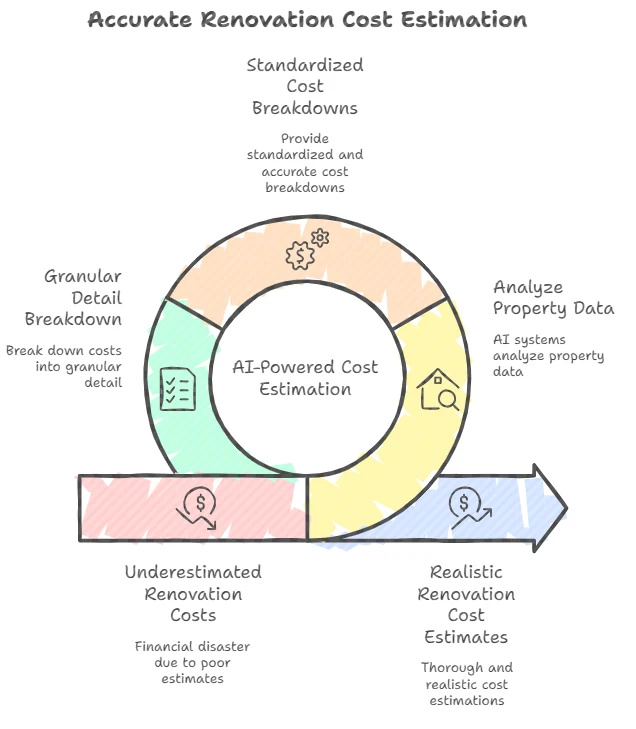
The Detailed Breakdown: Every Line Item Matters
The “Contingency” Cushion: Planning for the Unexpected
Always build a contingency fund into your renovation budget, typically 10-20%. Surprises will happen. You might find mold behind a wall, outdated electrical wiring that needs a complete overhaul, or a structural issue you didn’t foresee. Your contingency is your lifeline to absorb these unexpected costs without derailing your entire project.
Off-Market Advantage: Finding Gems Before the Masses
The most profitable deals are often off-market. This doesn’t mean they’re unavailable; it means they haven’t been listed on the Multiple Listing Service (MLS) for everyone to see. Pro investors actively cultivate networks and employ strategies to uncover these hidden opportunities.
Sourcing Off-Market Deals: Your Network is Your Net Worth
- Real Estate Agents: Develop strong relationships with agents who specialize in distressed properties or off-market listings.
- Wholesalers: These individuals find deals and assign contracts to investors. You’ll need to vet them carefully.
- Direct Mail Marketing: Sending postcards or letters to specific property owners (e.g., absentee owners, those behind on taxes) can yield results.
- Driving for Dollars: Literally driving through neighborhoods and identifying distressed or vacant properties, then researching the owners.
- Public Records: Tax delinquent lists, probate records, and foreclosure notices can point to potential sellers.
- Networking Events: Connect with other investors, attorneys, and contractors who might have leads.
Analyzing Off-Market Deals: Increased Diligence Required
When you find an off-market deal, the analysis process remains similar, but you might have less readily available information. This means your due diligence needs to be even more rigorous.
Cash Flow and Cap Rate Focus
For off-market rentals, you’ll still be heavily focused on cash flow and cap rates. Since you’re likely negotiating directly with the seller, there might be more room for favorable terms, but you must ensure the underlying economics still make sense.
Tax Implications for Off-Market Purchases
Understand the tax implications of purchasing an off-market property. This can vary significantly depending on the type of entity you’re buying through (LLC, individual) and the specific tax laws in your jurisdiction. Consult with a real estate attorney or CPA.
The 4 Ways to Win Framework: A Quick Deal Filter
As you begin to analyze dozens, if not hundreds, of potential deals, a quick and efficient evaluation method becomes invaluable. The 4 Ways to Win Framework is a rapid assessment tool designed to help you quickly identify promising opportunities. This is a 90-second evaluation that focuses on identifying properties that excel in at least two out of four key areas.
The Four Pillars of Winning Deals:
- Cash Flow: Does the property reliably generate positive monthly income after all expenses?
- Principal Recapture: How quickly will your mortgage principal be paid down, increasing your equity?
- Passive Appreciation: Does the property have strong potential to increase in value due to market forces beyond your direct control?
- Active Appreciation: Can you add significant value through strategic renovations and improvements that increase the property’s market value?
Applying the 4 Ways to Win:
- Goal: A deal must win in at least two of these four categories.
- Caveat: Crucially, a deal cannot have bad cash flow losses. Even if it scores high on appreciation, if it bleeds money monthly, it’s likely not a winner.
This framework allows you to quickly disqualify deals that don’t meet your minimum criteria, saving you valuable time and energy for the properties that truly have potential.
Due Diligence: The Non-Negotiable Step
Regardless of how good a deal looks on paper, due diligence is the non-negotiable phase that can make or break your investment. This is your opportunity to uncover any hidden problems or red flags that weren’t apparent during your initial analysis.
Map-Driven Due Diligence: Understanding the Neighborhood
Your analysis shouldn’t stop at the property lines. Engage in map-driven due diligence. This involves:
- Zoning and Land Use: Understand what you can and cannot do with the property. Are there future development plans in the area that could impact your investment?
- Flood Zones and Environmental Hazards: Identify any potential risks that could increase insurance costs or require expensive mitigation.
- School Districts and Demographics: These factors can significantly influence rental demand and property appreciation.
- Proximity to Amenities and Transportation: Access to jobs, shopping, and public transit is a strong indicator of desirability.
Inspections: Calling in the Professionals
- General Home Inspection: A thorough inspection by a qualified professional will reveal the condition of the roof, foundation, plumbing, electrical systems, HVAC, and more.
- Specialty Inspections: Depending on the property, you might need inspections for pests (termites), mold, asbestos, lead paint, or foundation issues.
- Sewer Scope: Especially important for older homes, this can identify costly problems with the main sewer line.
Legal Compliance and Understanding Title
- Title Search: Ensure the seller has clear title to the property and there are no liens or encumbrances that could jeopardize your ownership.
- HOA Documents (if applicable): Review the covenants, conditions, and restrictions of any homeowners’ association.
- Lease Agreements (if occupied): If the property is currently rented, carefully review all existing lease agreements.
adopting this systematic, data-driven, and rigorously cautious approach, you’ll move from being a hopeful property observer to a shrewd real estate analyst. You’ll learn to see past the superficial and uncover the true financial potential—or pitfalls—of any given deal, setting yourself on the path to consistent and profitable real estate investing.
FAQs
What is real estate deal analysis?
Real estate deal analysis is the process of evaluating the financial viability and potential return on investment of a real estate opportunity. This involves assessing factors such as property value, rental income, expenses, and market trends.
What are the key components of real estate deal analysis?
Key components of real estate deal analysis include determining the property’s potential rental income, estimating expenses such as maintenance and property management, evaluating the property’s appreciation potential, and assessing the local market conditions.
How do you calculate the potential return on investment for a real estate deal?
To calculate the potential return on investment for a real estate deal, you can use metrics such as the cap rate, cash-on-cash return, and internal rate of return (IRR). These metrics take into account factors such as property value, rental income, expenses, and financing costs.
What are some common mistakes to avoid when analyzing a real estate deal?
Common mistakes to avoid when analyzing a real estate deal include underestimating expenses, overestimating rental income, not accounting for vacancy rates, ignoring market trends, and not conducting thorough due diligence on the property.
What are some tips for analyzing a real estate deal like a pro?
Some tips for analyzing a real estate deal like a pro include conducting thorough market research, using conservative estimates for income and expenses, seeking advice from experienced investors or real estate professionals, and staying updated on industry trends and regulations.