
Embarking on the journey of real estate investment is an exciting and potentially lucrative endeavor. However, before you can reap the rewards of passive income, appreciation, or strategic development, you must first navigate the crucial landscape of financing. This guide aims to demystify real estate investment financing, providing you with a comprehensive understanding of the options available, the considerations involved, and strategies to secure the capital you need to build your portfolio.
Before you even begin to explore financing options, it’s paramount to undertake a thorough assessment of your own financial situation. This inward reflection will serve as the foundation for all subsequent decisions, dictating the types of properties you can afford, the loan products you qualify for, and ultimately, your investment strategy.
Assessing Your Creditworthiness
Your credit score is a powerful indicator of your financial responsibility and will heavily influence the terms and rates you’re offered. A strong credit score (typically 700+) will open doors to better interest rates and more favorable loan conditions.
- Review Your Credit Report: Obtain free copies of your credit report from all three major bureaus (Experian, Equifax, and TransUnion) annually. Scrutinize them for any inaccuracies or discrepancies that could be negatively impacting your score.
- Identify and Rectify Issues: If you find errors, dispute them immediately. Address any outstanding debts, late payments, or collections accounts to improve your standing.
- Maintain Healthy Credit Habits: Continue to pay bills on time, keep credit utilization low, and avoid opening too many new credit accounts simultaneously.
Evaluating Your Down Payment Capacity
The amount of money you can comfortably put down upfront significantly impacts the size of the loan you’ll need and the loan-to-value (LTV) ratio. A larger down payment reduces your risk to the lender and can lead to more favorable loan terms.
- Liquid Assets: Determine how much cash you have readily available in savings, checking accounts, or other highly liquid investments that you are willing to commit to a down payment.
- Alternative Capital Sources: Consider if you have access to other funds, such as gifts from family, proceeds from the sale of another asset, or a portion of your retirement savings (after careful consideration of penalty implications and financial advisor consultation).
- Emergency Fund: Crucially, ensure that any funds allocated for a down payment do not deplete your emergency fund. You need a buffer for unexpected repairs, vacancies, or market downturns.
Analyzing Your Debt-to-Income Ratio (DTI)
Your DTI is a key metric lenders use to assess your ability to manage monthly debt payments in addition to a new mortgage. It’s calculated by dividing your total monthly debt payments by your gross monthly income.
- Aim for a Lower DTI: Lenders generally prefer a DTI of 36% or less, though some programs may allow for higher ratios. A lower DTI indicates a higher capacity to take on additional debt.
- Strategies to Reduce DTI: Pay down existing debts, increase your income (if possible), or explore ways to consolidate high-interest debts to lower monthly payments.
- Impact on Loan Approval: A high DTI can make it more challenging to qualify for a loan or may result in less attractive loan terms.
Traditional Financing Avenues
Once you have a clear picture of your financial standing, you can begin to explore the most common financing options available for real estate investments. These traditional avenues often provide stable, long-term solutions, but they come with specific requirements and considerations.
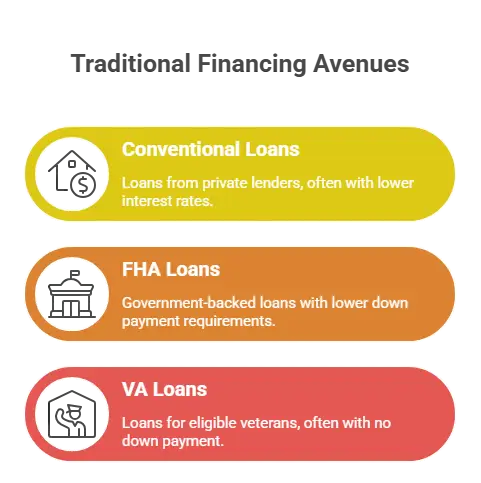
Conventional Loans
Conventional loans are the most common type of mortgage and are offered by private lenders such as banks, credit unions, and mortgage companies. They are not insured or guaranteed by a government agency.
- Down Payment Requirements: Typically require a down payment of 20% or more to avoid private mortgage insurance (PMI). However, some conventional loans allow for as little as 3-5% down, though PMI will be required.
- Credit Score and DTI: Generally require strong credit scores (mid-600s or higher) and a favorable DTI ratio.
- Property Type Flexibility: Can be used for various property types, including single-family homes, multi-family properties (up to 4 units), and even some commercial properties, depending on the lender.
- Loan Limits: Subject to loan limits set by government-sponsored enterprises like Fannie Mae and Freddie Mac. Loans exceeding these limits are considered “jumbo loans” and have stricter underwriting criteria.
FHA Loans (Limited for Investors)
While primarily designed for owner-occupants, FHA loans can sometimes be used for investors who intend to occupy one unit of a multi-unit property (up to four units).
- Low Down Payment: Offer very low down payment requirements, typically 3.5%.
- More Lenient Credit Requirements: FHA loans generally have more flexible credit score requirements compared to conventional loans.
- Mortgage Insurance Premiums (MIP): Require both upfront and annual mortgage insurance premiums, which can add to the overall cost of the loan. This is a significant consideration for investors.
- Owner-Occupancy Rule: The primary hurdle for investors is the owner-occupancy requirement. You must intend to live in one of the units for a specified period.
VA Loans (If Applicable)
If you are a veteran, active-duty service member, or eligible surviving spouse, a VA loan can be an incredibly attractive option due to its numerous benefits.
- No Down Payment: One of the most significant advantages is the ability to purchase a home with no down payment (for eligible borrowers and within loan limits).
- No Mortgage Insurance: VA loans do not require private mortgage insurance (PMI), saving you a significant amount over the life of the loan.
- Competitive Interest Rates: Often offer some of the most competitive interest rates in the market.
- Owner-Occupancy Rule: Similar to FHA loans, VA loans generally require the property to be your primary residence. However, qualified veterans can use their VA loan benefit for multi-unit properties (up to four units) if they occupy one of the units.
Advanced and Alternative Financing Strategies
Beyond traditional mortgages, a wealth of advanced and alternative financing strategies exist for real estate investors. These options can be particularly useful for specific property types, market conditions, or when traditional financing proves challenging.
Hard Money Loans
Hard money loans are short-term, asset-based loans typically provided by private individuals or companies. They are often used for quick purchases, renovation projects, or when traditional financing isn’t feasible.
- Asset-Based Lending: Lenders focus primarily on the value of the property being financed (the “collateral”) rather than the borrower’s creditworthiness.
- Quick Closings: Known for their speed, hard money loans can close in a matter of days or weeks, making them ideal for time-sensitive deals.
- Higher Interest Rates and Fees: Due to the higher risk associated with these loans, interest rates are significantly higher than traditional mortgages, and they often come with substantial origination fees.
- Short Terms: Typically have loan terms ranging from 6 months to 3 years.
- Best Use Cases: Ideal for fix-and-flip projects, bridging loans between property sales, or acquiring properties quickly before securing long-term financing.
Private Money Loans
Similar to hard money loans, private money loans come from individuals rather than institutional lenders. However, they tend to be more flexible and can be a good option for investors with strong relationships.
- Relationship-Based: Often fueled by personal relationships with individuals (friends, family, or other investors) who are looking to lend money for a return.
- Flexible Terms: Terms are negotiated directly between the borrower and the lender, offering more flexibility compared to institutional loans.
- Potential for Better Rates: If you have a strong relationship and a solid investment plan, you might secure more favorable rates than with hard money lenders.
- Due Diligence is Key: Even with private lenders, it’s crucial to have a clear, legally binding loan agreement outlining all terms, interest rates, repayment schedules, and collateral.
Portfolio Loans
Portfolio loans are offered by banks or credit unions that don’t sell their mortgages on the secondary market. Instead, they keep the loans in their own portfolio, giving them more flexibility in their underwriting criteria.
- Non-Standard Properties: Can be a good option for properties that don’t fit traditional lending guidelines, such as properties with unique zoning, mixed-use, or those with minor structural issues.
- Relationship Lending: Often more accessible to borrowers with existing banking relationships and a proven track record.
- Flexible Underwriting: Lenders have more discretion in evaluating applications, potentially offering solutions for borrowers who might not qualify for conventional loans.
- Potential for Higher Rates: Because the bank holds the loan, rates might be slightly higher than conventional loans, but the flexibility can be a valuable trade-off.
Commercial Loans
For larger multi-family properties (typically 5+ units) or dedicated commercial real estate, you’ll need to explore commercial loans. These differ significantly from residential mortgages.
- Property-Specific Underwriting: Lenders primarily focus on the income-generating potential of the property itself, including its net operating income (NOI) and debt service coverage ratio (DSCR).
- Shorter Terms: Commercial loans typically have shorter amortization periods (10-25 years) compared to residential loans, with balloon payments often required at the end of the term.
- Higher Down Payments: Generally require larger down payments, often 25% to 40% or more.
- Recourse vs. Non-Recourse: Commercial loans can be recourse (meaning you are personally liable for the debt) or non-recourse (meaning only the property serves as collateral). Non-recourse loans are more common for larger, experienced investors.
Seller Financing (Owner Financing)
Seller financing occurs when the seller of a property acts as the lender, offering you a loan to purchase the property. This can be a creative and effective way to secure a deal, especially in certain market conditions.
- Negotiated Terms: All loan terms, including interest rate, down payment, and repayment schedule, are negotiated directly between you and the seller.
- Flexibility: Offers significant flexibility, potentially allowing for lower down payments, more favorable interest rates, or a temporary period of interest-only payments.
- Reduced Closing Costs: Can lead to lower closing costs as you avoid many of the fees associated with traditional lenders.
- Benefits for Sellers: Can be attractive to sellers who want to defer capital gains taxes, earn passive income on their equity, or facilitate a sale in a slow market.
Strategic Considerations for Securing Financing
Beyond simply knowing your options, effectively securing real estate investment financing requires strategic planning and a proactive approach.
Crafting a Compelling Business Plan
Even for a single rental property, approaching your investment like a business is crucial. A well-thought-out business plan demonstrates your professionalism and understanding to lenders.
- Detailed Property Analysis: Provide comprehensive details about the property, including its location, condition, current value, and anticipated renovations or improvements.
- Market Analysis: Include a thorough analysis of the local market, including rental rates, vacancy rates, comparable sales, and future growth projections.
- Financial Projections: Present realistic pro forma statements, outlining anticipated income, expenses, cash flow, and return on investment (ROI).
- Exit Strategy: Clearly articulate your long-term plan for the property, whether it’s holding for appreciation, selling after renovation, or refinancing.
Building a Strong Investor Profile
Lenders look for reliable borrowers. Cultivating a strong investor profile increases your chances of approval and can lead to better loan terms.
- Track Record: If you have prior investment experience, even modest, highlight your successes and lessons learned.
- Team of Professionals: Demonstrate that you have a supportive team, including a real estate agent, attorney, accountant, and contractors.
- Continuing Education: Show a commitment to learning and staying informed about the real estate market and investment strategies.
- Transparency: Be open and honest with lenders about your financial situation and investment goals.
Networking and Relationship Building
Many of the more flexible or alternative financing options are found through networking and personal connections.
- Local Real Estate Investment Associations (REIAs): Attend meetings, workshops, and events to connect with other investors, lenders, and industry professionals.
- Online Forums and Groups: Participate in online communities to glean insights and build relationships.
- Introduce Yourself to Lenders: Don’t wait until you need a loan to introduce yourself to local banks and mortgage brokers. Build relationships in advance.
- Private Money Connections: Actively network to identify individuals who might be interested in private lending opportunities.
Understanding Loan Terms and Conditions
Never sign a loan agreement without fully understanding every clause and condition. This includes interest rates, repayment schedules, fees, collateral requirements, and default provisions.
- Fixed vs. Adjustable Rates: Understand the difference between fixed-rate loans (where the interest rate remains constant) and adjustable-rate mortgages (ARMs, where the rate can change over time).
- Amortization Schedule: Review how your principal and interest payments are structured over the life of the loan.
- Prepayment Penalties: Be aware of any penalties for paying off your loan early, which can be common in commercial or hard money loans.
- Escrow Accounts: Understand if the loan requires an escrow account for property taxes and insurance.
- Default Clauses: Know the consequences of defaulting on your loan and what actions the lender can take.
The Due Diligence Checklist for Financing
Before committing to any financing option, conduct thorough due diligence to ensure it aligns with your investment strategy and risk tolerance.
Analyzing the Total Cost of Financing
Look beyond the advertised interest rate to understand the true cost of your loan.
- Origination Fees: These are fees charged by the lender for processing your loan, typically a percentage of the loan amount.
- Closing Costs: Include attorney fees, appraisal fees, title insurance, recording fees, and other charges incurred at closing.
- Points: Fees paid directly to the lender at closing in exchange for a lower interest rate (1 point equals 1% of the loan amount).
- Prepayment Penalties: Factor in any costs associated with paying off the loan earlier than scheduled.
- Mortgage Insurance: If applicable, include the cost of PMI or MIP in your calculations.
Evaluating Risk and Reward
Every financing option comes with its own set of risks and potential rewards. Assess these carefully.
- Interest Rate Risk: The risk that interest rates will rise, affecting your monthly payments (for ARMs) or making refinancing more expensive.
- Liquidity Risk: The risk that you may not be able to quickly sell an asset if needed to repay a loan.
- Market Risk: The risk that property values in your market could decline.
- Tenant Risk: The risk of vacancies or non-paying tenants impacting your ability to cover mortgage payments.
- Leverage Risk: While leverage amplifies returns, it also amplifies losses. Understand how much debt you are comfortable taking on.
Comparing Multiple Offers
Never settle for the first loan offer you receive. Shop around and compare terms from multiple lenders.
- Get Pre-Approved: Obtain pre-approvals from several lenders to understand your borrowing capacity and compare terms.
- Request Detailed Loan Estimates: Carefully review the Loan Estimate document, which outlines all loan terms and fees in a standardized format.
- Negotiate Terms: Don’t be afraid to negotiate interest rates, fees, or other loan terms. Even a small reduction can save you a significant amount over time.
- Read the Fine Print: Ensure you understand all the terms before committing to a lender.
In conclusion, financing real estate investments is a multifaceted process that demands careful planning, diligent research, and a strategic approach. understanding your own financial standing, exploring the diverse financing avenues available, and applying a rigorous due diligence process, you can confidently secure the capital needed to build a successful and profitable real estate portfolio. Remember, the right financing can be just as crucial as the right property in achieving your investment goals.
FAQs
What are the common ways to finance real estate investments?
There are several common ways to finance real estate investments, including traditional bank loans, private money lenders, hard money loans, seller financing, and using a self-directed IRA or 401(k) to invest in real estate.
What is a traditional bank loan for real estate investment?
A traditional bank loan for real estate investment is a loan obtained from a bank or financial institution to purchase a property. These loans typically have lower interest rates and longer repayment terms, but they also require a good credit score and a substantial down payment.
What is a hard money loan for real estate investment?
A hard money loan is a type of short-term financing typically used by real estate investors to purchase and renovate a property. These loans are secured by the property itself and are often provided by private investors or companies. They have higher interest rates and shorter repayment terms compared to traditional bank loans.
How does seller financing work for real estate investment?
Seller financing, also known as owner financing, occurs when the seller of a property provides financing to the buyer. This can be beneficial for both parties, as it allows the buyer to purchase the property without a traditional bank loan, and the seller to receive regular payments with interest.
Can I use a self-directed IRA or 401(k) to finance real estate investments?
Yes, it is possible to use a self-directed IRA or 401(k) to invest in real estate. This allows individuals to use their retirement funds to purchase real estate properties, and any income or gains from the investment can grow tax-deferred or tax-free, depending on the type of account. However, there are specific rules and regulations that must be followed when using retirement funds for real estate investments.