If you own or plan to own an income property, learning how to calculate rental property ROI is one of the most important skills you can develop. ROI, or return on investment, tells you how efficiently your money is working for you and helps you compare one property against another using real numbers instead of guesswork.
- What Is Rental Property ROI
- Why Calculating ROI Matters for Investors
- Key Formulas Used to Calculate Rental Property ROI
- Step by Step Process to Calculate Rental Property ROI
- Factors That Affect Rental Property ROI
- Common Mistakes to Avoid When Calculating ROI
- Tips to Improve Your Rental Property ROI
- Conclusion
- FAQs
What Is Rental Property ROI
Rental property ROI is a measurement that shows how much profit an investment property generates relative to what you put into it. It combines rental income, expenses, and appreciation into a single percentage that reflects the overall performance of the property.
Understanding this number allows investors to make informed decisions rather than relying on assumptions about a neighborhood or a property’s appearance.
Why Calculating ROI Matters for Investors
ROI is more than a number on a spreadsheet. It helps investors evaluate whether a property is actually generating meaningful returns or simply breaking even. It also allows for apples to apples comparisons between different properties, even when they vary in size, location, or financing structure.
Without a clear ROI calculation, it becomes difficult to know if a rental is truly building wealth or just covering its own costs.
It Supports Long Term Planning
Knowing your ROI helps you plan future purchases, refinancing decisions, and portfolio growth with more confidence.
It Highlights Underperforming Assets
A low ROI can signal that a property needs better management, updated rental rates, or a change in strategy.
Key Formulas Used to Calculate Rental Property ROI
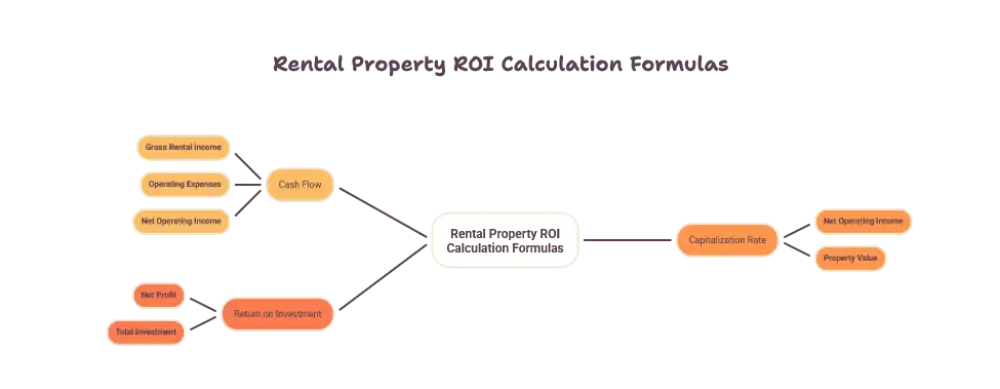
There are several ways to calculate ROI for a rental property, and each method offers a slightly different perspective on performance.
Cash on Cash Return
This method compares the annual cash flow generated by the property to the actual cash invested. It is especially useful for investors who financed the property, since it isolates the return on the money they personally contributed rather than the full property value.
Cap Rate Method
The capitalization rate looks at the property’s net operating income relative to its overall value. This approach is useful for comparing properties independent of financing, since it focuses purely on the income producing potential of the asset itself.
Total ROI Formula
This broader formula factors in rental income, expenses, and any appreciation in property value over time. It gives a more complete picture of long term performance rather than focusing only on annual cash flow.
Step by Step Process to Calculate Rental Property ROI
Calculating ROI becomes much easier when broken into a clear process.
Gather Your Property Financials
Start by collecting all relevant financial details, including rental income, operating expenses, insurance, taxes, maintenance costs, and any financing terms. Accurate records make the entire calculation more reliable.
Determine Your Net Operating Income
Net operating income is calculated by subtracting all operating expenses from the total rental income generated by the property. This figure reflects how much the property actually earns before financing costs are considered.
Apply the ROI Formula
Once you have your net operating income and total investment amount, you can divide the net income by the total investment to produce a percentage. This percentage represents your rental property ROI and can be compared across multiple properties.
Factors That Affect Rental Property ROI
Several elements influence how strong or weak a property’s ROI will be over time.
Location and Market Conditions
Neighborhood demand, rental trends, and local economic activity all play a major role in determining how much income a property can realistically generate.
Property Management Efficiency
Well managed properties tend to experience fewer vacancies, lower maintenance issues, and more consistent rental income, all of which support stronger ROI.
Financing Structure
The way a property is financed affects cash flow and, in turn, the overall return. Different loan terms and repayment structures can shift ROI significantly even when the property itself performs the same.
Common Mistakes to Avoid When Calculating ROI
Many investors miscalculate ROI by overlooking hidden costs such as vacancy periods, maintenance reserves, or property management fees. Others fail to update their calculations regularly, relying on outdated figures that no longer reflect current performance.
Another common mistake is focusing only on rental income while ignoring expenses that quietly reduce profitability over time. A clear and consistent calculation method helps avoid these pitfalls.
Tips to Improve Your Rental Property ROI
Improving ROI often comes down to increasing income, reducing unnecessary expenses, and managing the property efficiently. Simple upgrades, better tenant screening, and proactive maintenance can all contribute to stronger long term performance.
Reviewing your numbers on a regular basis also helps you catch issues early and adjust your strategy before small problems affect your overall returns.
Conclusion
Learning how to calculate rental property ROI gives investors a clear, data driven way to evaluate performance and make smarter decisions. understanding the different formulas, gathering accurate financial data, and reviewing results consistently, you can build a rental portfolio that performs well and grows steadily over time.
FAQs
What is a good ROI for a rental property?
A good ROI varies by market and investment goals, but most investors look for a return that comfortably exceeds what they could earn from a low risk investment while also accounting for ongoing expenses and maintenance.
How often should I recalculate my rental property ROI?
It is best to review ROI at least once a year, or whenever there is a significant change in rental income, expenses, or financing terms.
Does rental property ROI include appreciation?
Some ROI methods include appreciation while others focus purely on income performance, so it depends on which formula you choose to use.
What is the difference between cap rate and cash on cash return?
Cap rate measures income relative to property value without factoring in financing, while cash on cash return measures income relative to the actual cash invested by the owner.
Can ROI calculations help me compare multiple properties?
Yes, calculating ROI using a consistent method allows you to compare different properties fairly, even if they differ in size, location, or financing structure.