You stand at the precipice of a monumental shift in the world of property investment. The familiar landscape you once navigated, with its spreadsheets, endless site visits, and reliance on instinct, is rapidly evolving. Today, a new force has entered the arena, one that promises to redefine how you identify opportunities, execute transactions, and ultimately, maximize your returns. That force is Artificial Intelligence, and it’s not just a buzzword; it’s a game-changer that you can no longer afford to ignore.
Imagine a world where the tedious, time-consuming aspects of property transactions are handled with unparalleled speed and accuracy. This isn’t a futuristic fantasy; it’s your present reality with AI.
Streamlining Title and Settlement Processes
The traditionally labyrinthine processes of title searches and settlement are being revolutionized. AI-driven platforms are stepping in, automating a significant portion of these workflows. Think about the sheer volume of documents, regulations, and historical data involved in verifying ownership and preparing for closing. Manually, this can take weeks, even months, and is prone to human error. With AI, these platforms can sift through vast datasets, identify discrepancies, and generate reports at a speed that was once unthinkable. This automation translates directly into gains for you, with companies like First American Financial already witnessing productivity leaps of up to five times. This means less waiting, fewer revisions, and a faster pathway to closing your deals.
Learning from Data for Enhanced Accuracy
Crucially, these AI systems aren’t just following a set of pre-programmed rules. They are learning. Every successful transaction, every identified anomaly, every piece of legal precedent fed into their algorithms refines their capabilities. This continuous learning allows them to become increasingly accurate in their assessments, identifying potential title defects or settlement complexities that might elude even the most experienced human eye. You benefit from this cumulative intelligence, gaining a deeper and more reliable understanding of your investment’s legal standing.
Reshaping Roles and Empowering Your Team
The introduction of AI in these areas isn’t about replacing your entire team; it’s about reshaping roles and empowering your existing workforce. Tasks that were once manual and repetitive can now be handled by machines, freeing up your legal and administrative staff to focus on more complex problem-solving, client relations, and strategic decision-making. You’ll find your team can achieve more with less effort, adding significant value to your operation without a proportional increase in headcount.
AI-Powered Brokerages: A New Paradigm for Deals
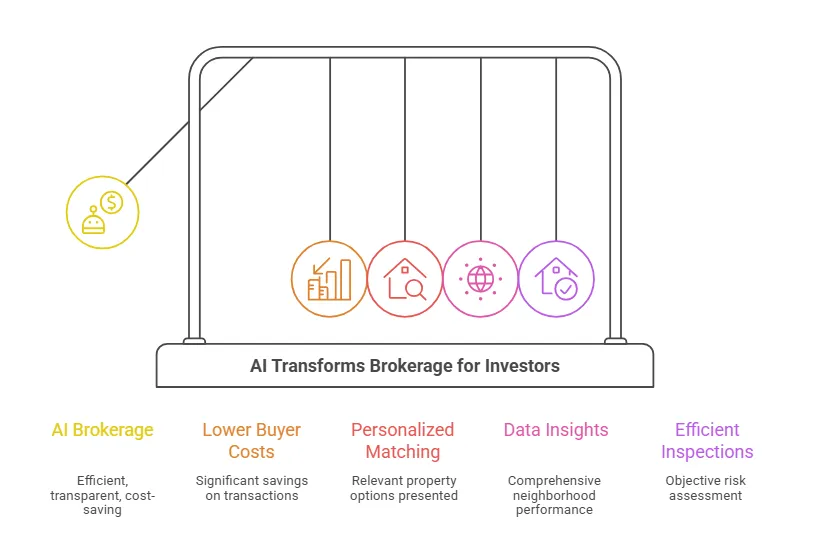
The traditional brokerage model, with its fixed commissions and sometimes opaque processes, is facing a powerful challenger. AI is enabling a new breed of brokerage that prioritizes efficiency, transparency, and significant cost savings for you, the investor.
Drastically Lowering Buyer Costs
Consider the impact of AI-powered brokerages like Turbo Home. They are fundamentally altering the cost structure of property acquisition. leveraging virtual agents, sophisticated neighborhood sales comparisons, and AI-driven inspection insights, these platforms are slashing overheads and passing those savings directly to you. We’re talking about potential savings of over $45,000 on a single transaction. This isn’t just a minor discount; it’s a substantial reduction in your acquisition costs, directly boosting your overall profitability and making more deals financially viable.
Virtual Agents and Personalized Matching
These virtual agents aren’t just chatbots; they are intelligent systems capable of understanding your investment criteria, scouring vast databases of properties, and presenting you with highly relevant options. They can conduct initial screenings, answer common questions, and even schedule virtual tours, all without human intervention. This personalization ensures you’re not sifting through irrelevant listings, saving you invaluable time and focusing your efforts on properties that truly align with your investment strategy.
Data-Driven Neighborhood Insights
Gone are the days of relying solely on anecdotal evidence or limited comparative market analyses. AI-powered platforms provide you with unparalleled insights into neighborhood performance. They analyze everything from historical price trends and rental yields to demographic shifts, school ratings, and even local amenities. Imagine having a comprehensive, data-driven report on any neighborhood you’re considering, giving you a competitive edge in understanding market dynamics and future growth potential.
Efficient and Objective Inspections
The inspection phase, often a point of anxiety in any property transaction, is also becoming more efficient and objective. AI can analyze inspection reports, flagging critical issues, estimating repair costs, and even cross-referencing against similar properties for comparative analysis. This helps you quickly assess the true condition of a property and objectively evaluate potential risks, allowing you to make more informed negotiating decisions.
Empowering the Modern Property Pro
Even if you’re not directly using an AI-powered brokerage, the tools available to you as a property investor, or to your agents, are becoming incredibly sophisticated. The competitive landscape demands that you embrace these innovations.
Sophisticated Lead Generation and Re-engagement
Your focus as an investor is always on finding the next great opportunity. AI is transforming lead generation from a hit-or-miss endeavor into a highly targeted science. Tools like ListAssist allow top agents, and by extension, you, to perform natural language searches that go far beyond simple keyword matching. You can ask complex questions, such as “Show me multi-family properties in burgeoning tech hubs with an average rental yield of 7% and within a 20-minute commute of the city center.” The AI understands these nuanced requests, providing you with highly curated lists of potential investments. Furthermore, AI excels at re-engaging leads that might have gone cold. It can analyze past interactions, property viewings, and market changes to trigger personalized communications, ensuring that no potential opportunity slips through the cracks.
Automating Repetitive Tasks for Focus
The daily grind of property investment often involves numerous repetitive tasks – scheduling appointments, sending follow-up emails, updating CRM systems. AI is your digital assistant, capable of automating these menial activities. Imagine dictating a request for a showing, and the AI automatically syncs calendars, sends confirmation emails to all parties, and updates your property management software. This allows you to reclaim countless hours, redirecting your energy towards strategic analysis, networking, and critical decision-making that only you can do.
Building a Custom Tech Stack for Competitive Advantage
The beauty of the current AI landscape is its flexibility. You’re not beholden to a single platform. Instead, you can build a custom tech stack, integrating various AI tools that best serve your specific investment strategy. Perhaps you use one AI for market analysis, another for lead scoring, and a third for managing communication with tenants. This modular approach allows you to create a tailor-made system that maximizes your efficiency and gives you a significant competitive edge, allowing you to compete effectively with larger institutional investors and even established portals like Zillow. You’re no longer just reacting to the market; you’re actively shaping your approach with cutting-edge technology.
The Unbreakable Bond: Human Expertise Meets AI
Despite the incredible advancements, it’s imperative to understand that AI is a powerful tool, not a complete replacement for human ingenuity and judgment.
AI as an Accelerator, Not a Replacer
Industry analysis consistently highlights that while AI undeniably accelerates transactions and provides unprecedented insights, it cannot fully replace human expertise, particularly in critical areas. Think of it as a supercharger for your existing capabilities. You still need to understand the nuances of a local market, possess an intuitive understanding of human behavior in negotiations, and ultimately, make the final investment decision. AI streamlines the process, but the ultimate responsibility and strategic direction remain firmly in your hands.
The Irreplaceable Role in Fraud Prevention
One area where human oversight remains absolutely paramount is fraud prevention. While AI can identify suspicious patterns and red flags within data, the subtle machinations of fraudsters often require the discerning eye and critical thinking of a human expert. Complex property fraud schemes involve a sophisticated understanding of legal loopholes, interpersonal manipulation, and often, an element of social engineering that AI, at its current stage, cannot fully comprehend. Your vigilance, combined with AI’s ability to sift through data for anomalies, creates the most robust defense against potential threats to your investment.
Safeguarding Property Rights and Legal Complexities
Similarly, safeguarding property rights involves a deep understanding of evolving legal frameworks, local ordinances, and nuanced contractual language. While AI can analyze legal documents rapidly, interpreting their spirit, foreseeing potential future disputes, and navigating complex negotiations requires the judgment of legal professionals. The ethical implications, unforeseen consequences of clause interpretations, and the subjective nature of many legal disputes necessitate a human touch. You cannot outsource the full responsibility of protecting your precious property rights to an algorithm; it serves as a powerful assistant to your legal counsel.
Has AI “Broken” Property Investing?
| Metrics | Data |
|---|---|
| Property Valuation | AI algorithms can analyze large datasets to accurately predict property values. |
| Risk Assessment | AI can assess investment risks by analyzing market trends, property performance, and economic indicators. |
| Market Analysis | AI can provide insights into market trends, demand patterns, and investment opportunities. |
| Portfolio Management | AI tools can optimize property portfolios by identifying underperforming assets and suggesting investment strategies. |
| Customer Service | AI-powered chatbots and virtual assistants can enhance customer service for property investors and tenants. |
The rapid proliferation of AI tools begs a crucial question: has this technology “broken” property investing as we know it? Just hours ago, discussions have flared online about whether these new tools have fundamentally altered the investment landscape.
Redefining Competitive Edges
Perhaps “broken” isn’t the right word, but “redefined” certainly is. The playing field is undeniably changing. What once constituted a competitive edge – deep market knowledge, an extensive network, a knack for finding off-market deals – is now being amplified and, in some cases, democratized by AI. Smaller investors can now access sophisticated analytics previously only available to large institutions. Experienced professionals are finding their workflow streamlined and their insights deepened. The barrier to entry, in terms of data analysis, is significantly lowered.
Demanding Adaptation and Continuous Learning
For you, the property investor, this dynamic environment demands adaptation. Those who embrace AI, learn its capabilities, and integrate it into their strategies will thrive. Those who resist will find themselves increasingly outmaneuvered. It’s no longer enough to rely solely on traditional methods. You must commit to continuous learning, understanding how these new tools can enhance your deal sourcing, due diligence, portfolio management, and overall investment success.
Raising the Bar for Success
Ultimately, AI isn’t breaking property investing; it’s raising the bar. It’s making the market more efficient, more transparent, and more data-driven. This means that while opportunities might be identified more quickly, the necessity of sound judgment, strategic vision, and human integrity remains paramount. You are called upon to be more informed, more agile, and more discerning than ever before. The future of your property investment success hinges on your ability to harness the power of AI while remaining grounded in the timeless principles of prudent investing. The question then, isn’t whether AI has broken property investing, but rather, are you ready to master the new rules of the game?
FAQs
What is AI and how is it used in property investment?
AI, or artificial intelligence, refers to the simulation of human intelligence in machines that are programmed to think and act like humans. In property investment, AI is used to analyze large amounts of data to identify trends, predict market movements, and make investment decisions.
How does AI benefit property investors?
AI benefits property investors by providing them with valuable insights and analysis that can help them make more informed investment decisions. AI can also automate repetitive tasks, saving investors time and allowing them to focus on higher-level strategic planning.
What are some examples of AI applications in property investment?
Some examples of AI applications in property investment include predictive analytics to forecast property values, natural language processing to analyze market trends from news articles and social media, and machine learning algorithms to identify investment opportunities based on historical data.
Are there any challenges or limitations to using AI in property investment?
Challenges and limitations to using AI in property investment include the potential for biased or inaccurate data leading to flawed predictions, the need for skilled professionals to interpret AI-generated insights, and the risk of over-reliance on AI without considering other factors.
What is the future of AI in property investment?
The future of AI in property investment is likely to involve further advancements in machine learning and predictive analytics, as well as increased integration of AI tools into investment platforms and decision-making processes. As AI technology continues to evolve, it is expected to play an increasingly important role in shaping the future of property investment.