
Investing in commercial real estate can be an incredibly lucrative venture, but it requires a numbers driven approach to truly succeed. Unlike residential properties, where emotional appeal might play a minor role, commercial real estate is strictly business. Every decision hinges on profitability, cash flow, and long term value. To navigate this complex landscape, smart investors rely heavily on a data driven framework, and at the absolute center of that framework is the commercial property ROI calculator.
Understanding how to measure your return on investment is the difference between a thriving portfolio and a costly financial misstep. This comprehensive guide will explore how a commercial property ROI calculator works, why it is indispensable for modern real estate investors, and how you can accurately interpret the data it provides to maximize your financial returns.
- What is a Commercial Property ROI Calculator?
- Why You Need a Commercial Property ROI Calculator
- Key Metrics Evaluated by a Commercial Property ROI Calculator
- Essential Inputs for an Accurate Commercial Property ROI Calculation
- Step by Step Guide to Using a Commercial Property ROI Calculator
- Common Mistakes to Avoid When Calculating Commercial ROI
- How to Maximize the ROI of Your Commercial Property
- Choosing the Right Commercial Property ROI Calculator for Your Strategy
- Frequently Asked Questions
What is a Commercial Property ROI Calculator?
A commercial property ROI calculator is a specialized digital tool designed to help real estate investors estimate the potential profitability of a commercial real estate asset. Whether you are looking at a bustling retail strip, a suburban office building, a massive industrial warehouse, or a multi family apartment complex, this tool processes your financial inputs to deliver a clear picture of your investment performance over time.
Instead of relying on guesswork or manual spreadsheets that are prone to human error, the calculator simplifies complex mathematical equations into an easily digestible format. inputting specific financial variables, you instantly receive critical metrics that indicate whether a property is worth your capital or if you should walk away from the deal.
Why You Need a Commercial Property ROI Calculator
The commercial real estate market moves quickly, and great opportunities do not stay available for long. Having immediate access to a commercial property ROI calculator gives you a distinct competitive advantage.
- Objective Decision Making: It eliminates emotional bias by focusing strictly on cold, hard financial data.
- Rapid Property Comparison: You can quickly screen dozens of potential properties and filter out the ones that do not meet your financial criteria.
- Accurate Risk Assessment: altering variables like vacancy rates or maintenance costs, you can see how different scenarios impact your bottom line.
- Streamlined Lender Approval: Presenting clear, calculated ROI metrics to banks or private lenders significantly boosts your credibility and improves your chances of securing financing.
Key Metrics Evaluated by a Commercial Property ROI Calculator
To get the most out of a commercial property ROI calculator, you need to understand the primary metrics it computes. A truly valuable tool does not just output a single percentage, it breaks down your returns across several critical financial indicators.
Net Operating Income
Often abbreviated as NOI, this is the foundational metric for any commercial real estate analysis. Net Operating Income represents the total revenue generated by the property minus all necessary operating expenses. It is calculated before deducting taxes or mortgage payments. A reliable calculator uses your gross rental income and expense inputs to establish a precise NOI, which serves as the bedrock for calculating your overall returns.
Cap Rate
The capitalization rate is a core metric used to compare the relative value of different commercial properties. It is calculated by dividing the Net Operating Income by the current market value or purchase price of the property. The cap rate provides an estimate of your potential return if you were to purchase the property entirely with cash. It also reflects the perceived risk level of the asset class and location.
Cash on Cash Return
Most investors utilize leverage through financing rather than paying full cash for a property. This is where cash on cash return becomes essential. This metric measures the annual cash flow remaining after mortgage payments, relative to the actual amount of cash you initially invested out of pocket. A commercial property ROI calculator is invaluable here, as it factors in your down payment, closing costs, and loan terms to determine your true out of pocket return.
Internal Rate of Return
The Internal Rate of Return is a more sophisticated metric that accounts for the time value of money. It estimates the total profitability of an investment over its entire holding period, factoring in annual cash flows, projected rental growth, and the eventual profit from selling the property in the future.
Essential Inputs for an Accurate Commercial Property ROI Calculation
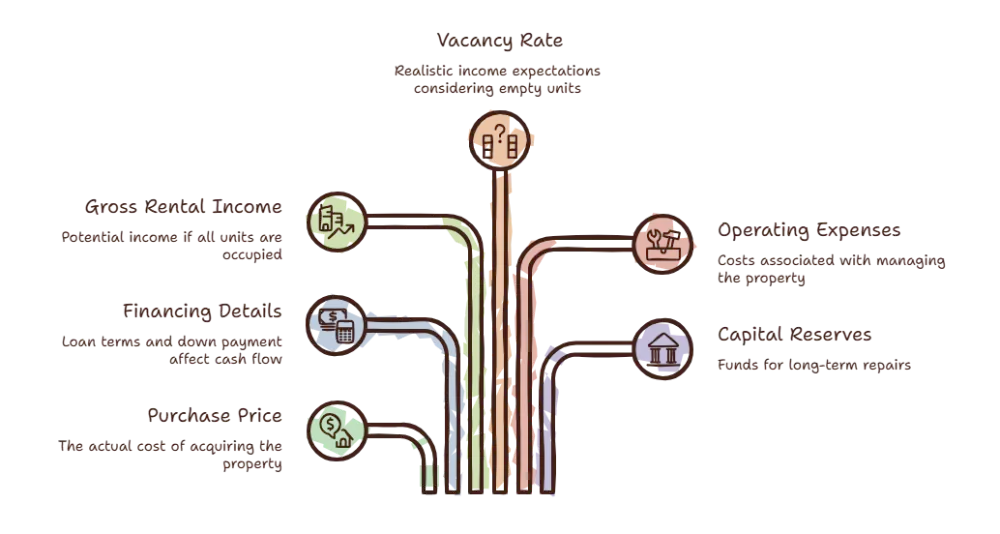
The old phrase “garbage in, garbage out” applies perfectly to financial tools. Your commercial property ROI calculator will only be as accurate as the data you provide. To get a precise evaluation, you must gather and input several key pieces of financial information.
- Purchase Price: The actual negotiated or expected buying price of the commercial asset.
- Financing Details: The size of your down payment, the interest rate on your loan, and the overall amortization period.
- Gross Rental Income: The total annual income generated if all units are occupied at current market lease rates.
- Vacancy Rate: An estimated percentage of time that units sit empty between tenants, which acts as a buffer for realistic income expectations.
- Operating Expenses: This includes property management fees, property taxes, insurance premiums, regular maintenance, and utilities not paid by tenants.
- Capital Reserves: Funds intentionally set aside for major long term repairs, such as replacing a roof or updating an HVAC system.
Step by Step Guide to Using a Commercial Property ROI Calculator
Using a commercial property ROI calculator effectively involves a systematic approach to analyzing a deal. Following these steps ensures you capture the full financial narrative of a property.
Step 1 Gather Verified Property Data
Never rely solely on marketing brochures or initial broker sheets. Request official profit and loss statements, current rent rolls, and historical utility bills from the seller. Having verified numbers is the only way to ensure your calculator outputs are grounded in reality.
Step 2 Enter the Primary Purchase and Loan Details
Start by inputting the total purchase price along with your estimated closing costs. Next, enter your financing details. Specify how much cash you are contributing as a down payment and enter the current interest rates offered by your commercial lender.
Step 3 Input All Projected Revenue and Expenses
Fill in the gross potential rent along with any auxiliary income sources, such as parking fees or laundry services. Be conservative with your vacancy rate input, as a higher vacancy allowance protects you from unexpected market downturns. Next, carefully log all operating expenses, ensuring you do not overlook recurring annual costs like insurance adjustments or local property tax updates.
Step 4 Analyze the Results and Run Sensitivity Testing
Review the generated cap rate, cash on cash return, and net operating income. Once you have a baseline calculation, perform sensitivity testing. Adjust the vacancy rate higher or increase the annual maintenance budget in the calculator to see if the property remains profitable even under less than ideal economic conditions.
Common Mistakes to Avoid When Calculating Commercial ROI
Even with a high quality commercial property ROI calculator, human errors during the input phase can skew your results and lead to poor investment decisions.
- Underestimating Vacancy Periods: Commercial leases take significantly longer to secure than residential ones. Assuming zero vacancy is a recipe for financial strain.
- Overlooking Hidden Operating Costs: Forgetting to budget for property management fees, regular landscaping, or local structural compliance checks can quickly erode your projected net operating income.
- Neglecting Lease Structures: Commercial real estate uses unique lease types. Ensure you know whether the tenant or the landlord is responsible for taxes, insurance, and maintenance before entering expense data.
- Ignoring Local Market Trends: A calculator cannot predict local economic shifts. Always pair your digital calculations with thorough local market research regarding tenant demand and employment growth.
How to Maximize the ROI of Your Commercial Property
Once your commercial property ROI calculator confirms that a property is a viable investment, your goal shifts to optimizing that asset to maximize your returns.
- Implement Strategic Property Upgrades: Modernizing common areas, improving energy efficiency, or adding smart building features can justify higher rental rates and attract premium tenants.
- Audit and Optimize Operating Expenses: Regularly review service contracts for landscaping, cleaning, and security to ensure you are getting competitive rates without sacrificing quality.
- Negotiate Longer Lease Terms: Securing multi year leases with established businesses minimizes vacancy risk and creates highly predictable cash flow patterns.
- Explore Additional Revenue Streams: Look for creative ways to monetize unused space, such as installing solar panels, renting out storage areas, or adding branded vending services.
Choosing the Right Commercial Property ROI Calculator for Your Strategy
Not all digital tools are built equally. When selecting a commercial property ROI calculator to assist with your portfolio growth, look for options that offer robust customization. The ideal tool should allow you to toggle between different commercial lease structures, adjust inflation rates for long term projections, and separate your upfront closing costs from your ongoing capital reserves. choosing a sophisticated and comprehensive calculator, you equip yourself with the financial clarity required to master the commercial real estate market.
Frequently Asked Questions
What is a good return on investment for commercial property?
A good ROI depends heavily on the specific asset class, the location, and current market conditions. Generally, many commercial real estate investors look for a capitalization rate between 5% and 8%, while aiming for a cash on cash return of 8% or higher to justify the risks associated with commercial properties.
How does a commercial property ROI calculator handle different lease types?
Advanced calculators allow you to specify whether a lease is a Gross Lease, where the landlord pays expenses, or a Triple Net Lease, where the tenant covers property taxes, insurance, and maintenance. This distinction drastically changes your operating expense inputs and your final net operating income.
Why is cash on cash return different from the cap rate?
The cap rate evaluates the property performance as if it were purchased entirely with cash, completely ignoring any mortgage details. Cash on cash return calculates the specific return on the actual currency you invested out of pocket, directly factoring in your debt service payments.
Can I use a residential calculator for commercial real estate?
It is highly discouraged. Commercial real estate involves unique variables such as complex lease structures, significantly higher vacancy periods, specific capital reserve requirements, and distinct expense categories that residential calculators simply do not account for.
How often should I recalculate my commercial property ROI?
You should utilize a commercial property ROI calculator during the initial vetting phase, again during active due diligence when verified financial documents arrive, and annually throughout your ownership period to track actual property performance against your initial projections.